

I left Utah in 2000 for a 13-year stretch chasing work opportunities around the country, and when I came back in 2013, the coffee scene here had genuinely started to change. It wasn't dramatic yet, but you could feel it — more shops, more people who actually cared what was in their cup.
Why Utah Was Late to Coffee
Utah's slow start with coffee has a specific, well-documented cause: the Word of Wisdom, a health code adopted by The Church of Jesus Christ of Latter-day Saints in 1833 that names "hot drinks" — later clarified by church leaders to mean coffee and tea specifically — as something to avoid. It wasn't strictly enforced until 1921, when it became a requirement for temple access, but by then the habit was culturally set. With most of the state's population belonging to the church for most of its history, coffee shops simply weren't in high demand the way they were elsewhere.
Worth knowing: the guidance is specifically about coffee and tea, not caffeine broadly. The church clarified in 2012 that caffeinated soda doesn't violate the Word of Wisdom — which goes a long way toward explaining why Utah has more soda shops per capita than almost anywhere else in the country.
Enter Swig, and a Different Kind of Ritual
Swig, the original "dirty soda" chain, started in St. George in 2010 and has grown to more than 160 locations across 16 states. The format — soda customized with cream and flavored syrups — became Utah's stand-in for the coffee shop experience: a drive-through ritual and a reason to meet up, minus the coffee. It's a genuinely Utah invention, and it says a lot about how much people here wanted the ritual even when coffee itself was off the table for a large share of the population.
A New Wave Moving In
That's changed a lot over the past couple decades. Utah's demographics have shifted, Starbucks expanded aggressively through the state, and — more interesting to me — a real specialty coffee scene has grown up alongside it. Publik Coffee Roasters roasts to order out of a solar-powered roastery in downtown Salt Lake City. Alpha Coffee sits right at the mouth of Big Cottonwood Canyon, with canyon views that make it feel more like a basecamp than a coffee shop — always packed with people fueling up before they head out to do something active. Honeysuckle Coffee, tucked into south Salt Lake City, is the opposite energy entirely: quiet, focused, the kind of place you go to actually get work done. Drive down I-15 today and you'll pass more genuinely good coffee shops than most people would expect from a state coffee mostly skipped for a century.
Built for the Outdoors, Built for Coffee
Part of what's driving this is Utah's outdoor culture. People here get outside — hiking, skiing, biking before or after work — and that same mindset carries over into how they think about coffee: something worth doing right, not just getting through. Add in how many people work remotely or hybrid now, laptop open at a coffee shop instead of a downtown office, and you've got a population with real reasons to start caring about a good cup.
Still Catching Up in Places
That said, the shift isn't complete. I was at a networking event recently with a spread of bagels and donuts — and the only drinks on the table were chocolate milk and soda. No coffee anywhere in sight. It was a good reminder that even with all the growth, plenty of Utah still hasn't caught up to the idea that a proper cup of coffee belongs on that table too. It's exactly why we built Work From Home around that same mindset — coffee that holds up whether your desk is in an office or a trailhead parking lot.
What Six States Taught Me About Coffee at Work
Over those 13 years, I lived in six different states, and coffee kept showing up as more than just a drink — it was how workplaces actually functioned. At Energizer's headquarters, a $4 billion CPG company, they'd regularly cater in Starbucks for meetings, and it worked: I could sit down with someone three levels up or three levels down and coffee gave us a reason to actually talk. Not every stop was like that — I worked at Honeywell in Ohio for a while, and the office coffee was genuinely bad. I dealt with it, because that's what you do, but it was a small, constant reminder that coffee at work is either an asset or an afterthought, and most places treat it like an afterthought.
Then I came to Utah to lead recruiting and people for HireVue. Office coffee there was outsourced to an EA who didn't drink coffee herself, for religious reasons — and every time she had to order it for a meeting, she'd come ask me for help and admit she felt a little guilty even placing the order. That stuck with me. She hadn't done anything wrong; a normal, ordinary part of running a workplace had become something a genuinely great employee felt awkward about, simply because nobody around her actually understood coffee.
Where Sumato Fits In
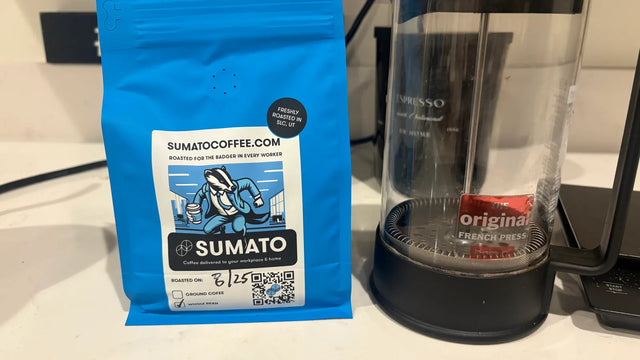
That gap — good coffee treated like an afterthought, or like something people feel weird about — is exactly what Sumato is built to close: a genuinely good cup of coffee in people's homes and workplaces, not just a handful of downtown cafes. But it's not only about the coffee itself. There's something good that happens the moment a pot starts brewing and that smell reaches the rest of the house or the office — people wander over, someone asks what you're drinking, a conversation starts that wouldn't have otherwise. That's the part we actually care about: not just fresh beans showing up on a schedule, but the small moments of connection that happen around a shared cup, whether that's a home kitchen table or a break room. The smell, the taste, the few minutes it gives you to actually talk to someone — there's real goodness in that, and it's worth building a coffee company around. If you want that same ritual wherever you're working from, that's exactly what our office and home office subscription is built for.
Utah, new or OG: what's your favorite coffee spot, and what's your best coffee-culture fail story — chocolate milk with a donut included? Tag us @sumatocoffee and tell us.
Find similar articles:
Salt Lake CityMentioned in this article
More stories
What's the Difference Between Light, Medium, and Dark Roast Coffee